
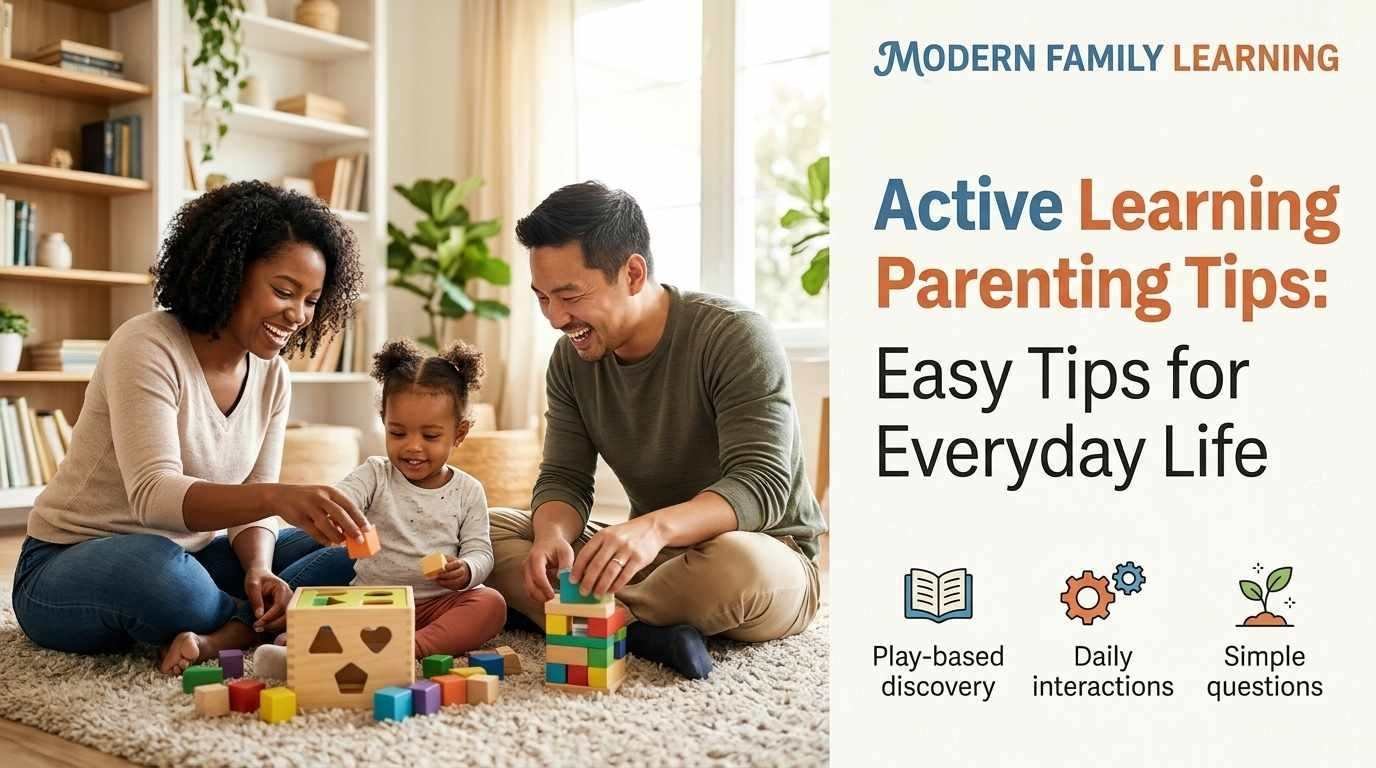
Most parents do not need another craft idea that takes a store run and an hour of cleanup. They need ideas that work on a normal Tuesday, with tired kids and half-made dinner. That is the thinking behind active learning fparentips: practical, low-prep ways to help children learn by doing. It is learning that fits around real life, not the other way around.
Active learning means a child is thinking, touching, testing and talking, not just listening. It can happen in the kitchen, the car or the bath as easily as in a classroom. This guide covers simple habits, honest advice on screens and boredom, and ways to keep learning from becoming one more chore. You can start with just one idea today.
Turning the 4:30 P.M. Slump Into a Learning Opportunity
Late afternoon is hard for many families. Children have held it together all day, and their patience runs low just as yours does. Hunger, tiredness and a need for attention often arrive at the same time.
Instead of fighting this window, give it a purpose. A child with a real job usually settles faster than one who is told to sit quietly. A real task gives restless energy somewhere useful to go.
Try these five-minute jobs:
- Match and pair clean socks
- Wash vegetables and name their colors and shapes
- Set the table and count plates, forks and spoons
- Guess which pot holds more water, then test the guess
Each task needs no prep, and the child feels useful. You get help, and the learning is built into the job. Even a toddler can take part in some way.
Keep it flexible. If your child is melting down, a snack and a hug come first. Children learn best when they feel safe and fed.
A short routine helps too. Try the same small job at the same time each day. Children feel calmer when they know what comes next, and the habit soon becomes part of the family rhythm.
What Active Learning at Home Really Means
Active learning at home means children learn through hands-on experience, choice and conversation instead of passive listening. They ask, try, fail and try again, while an adult stays close and supports. The adult guides gently instead of leading every step.
It does not require special kits, a schedule or constant entertainment. The basic ingredients are open-ended materials, unhurried time, real choices and a calm adult nearby. Most of these are already in your home.
Active learning also respects each child’s pace. One child may build for twenty minutes, while another moves quickly from task to task. Both are learning, and neither needs to be rushed.
| Everyday moment | Passive version | Active version |
| Dinner prep | Watching you cook | Measuring, stirring and tasting |
| Car ride | Tablet in the back seat | Spotting letters, counting red cars |
| Story time | Listening only | Predicting what happens next |
| Laundry | Waiting for you | Sorting by color, size or owner |
The difference is not the activity. It is whether the child is doing the thinking. When children do the thinking, the learning feels more meaningful to them.
Benefits of Active Learning for Child Development
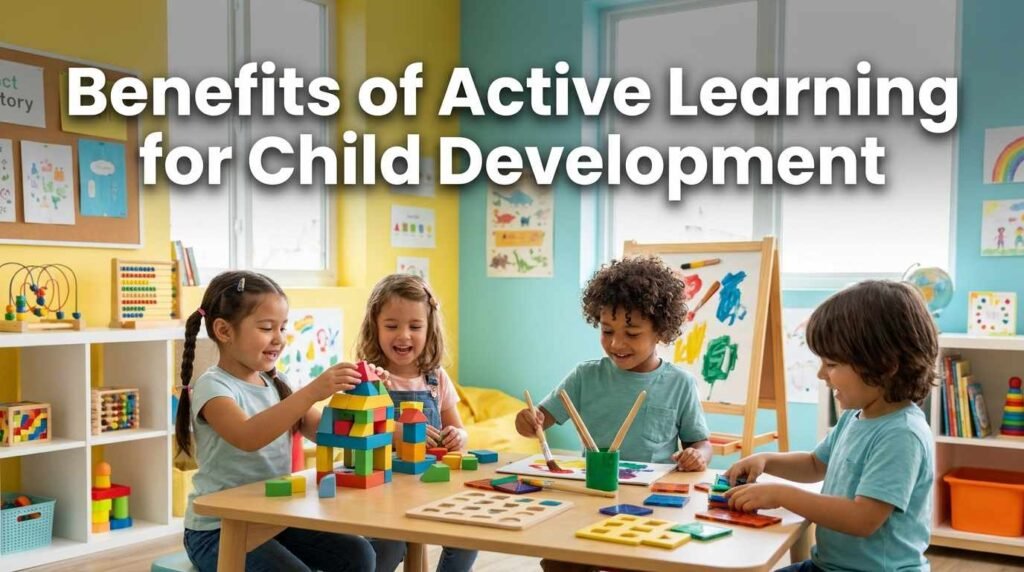
Hands-on learning supports many areas of early childhood development at once. Pediatric and early education groups, including the American Academy of Pediatrics, describe play as central to healthy growth. That makes everyday play a serious part of early childhood development.
Here is what regular active learning can build:
- Critical thinking: Children predict, test and adjust their ideas.
- Language skills: Talking while doing adds new words in context.
- Motor skills: Pouring, stacking and tearing strengthen small hand muscles.
- Self-regulation: Waiting for a turn or retrying after a failure builds patience.
- Confidence: Solving a small problem alone teaches a child that effort works.
- Memory: Children tend to remember what they do better than what they hear.
None of this needs a perfect setup. Small, repeated experiences matter more than one big activity. Consistency is what turns a good idea into a habit.
Over time, these small gains add up. A child who learns to think through a problem at home often brings that habit to school, where patience and curiosity help with reading, math and group work.
Why Blocks Are Better Than Worksheets
A worksheet asks a child to recall something already taught. A block tower asks a child to plan, predict and fix a problem when it falls. That feedback is immediate and needs no adult to grade it.
Building also develops spatial reasoning, balance and cause-and-effect thinking. Children usually talk through the process too, which supports vocabulary. A shared build also invites siblings and friends to cooperate.
| Feature | Blocks | Worksheets |
| Main skill | Spatial reasoning, planning | Recall, handwriting |
| Feedback | Instant, the tower falls | Delayed, adult marks it |
| Mistakes | Part of the fun | Often feel like failure |
| Child’s choice | High | Low |
| Natural conversation | Plenty | Very little |
| Best use | Exploring ideas | Practicing a known skill |
Worksheets still have a place, especially for practicing handwriting. For exploring and understanding, hands-on materials usually do more. Choose the tool that matches what your child is trying to learn.
A good middle path is to use both. Let your child build first, then draw or write about what they made. The hands-on step gives the paper work real meaning.
The Parent’s Role in Active Learning
The hardest part for many parents is stepping back. The urge to correct or demonstrate is strong, but children learn more when they work things out themselves. A little struggle, with you nearby, builds persistence.
Use this simple five-step approach:
- Watch first. See what your child is trying to do.
- Wait. Count to ten before stepping in.
- Describe. Say what you see: “You put the big block on the bottom.”
- Ask an open question. Try “What could you try next?”
- Follow their lead. Let their idea guide the play.
If a puzzle piece does not fit, do not hand over the right one. Stay nearby and let them feel the mismatch. Praise effort and ideas, not just correct answers.
Your tone matters as much as your words. A calm voice and a relaxed face tell your child that mistakes are safe. When you stay curious instead of corrective, they tend to copy that attitude.
Creating Learning Spaces Without a Dedicated Room
You do not need a playroom or a Pinterest corner. Children learn wherever they are allowed to take part. Your home already holds several mini classrooms.
| Place | Everyday activity | Skills built |
| Kitchen | Measuring, pouring, mixing | Math, science, coordination |
| Grocery store | Counting items, comparing sizes | Numbers, reading, choices |
| Bathroom | Pouring cups, squeezing sponges | Volume, cause and effect |
| Living room floor | Cushion forts, block towers | Engineering, planning |
| Car | Spotting signs and colors | Letters, observation |
Two small changes help. Keep one low bin of loose parts, such as boxes, lids, spoons and fabric scraps, where your child can reach it. Then leave a half-finished build alone for a day so they can return to it.
5 Activities to Try When Your Child Says “I’m Bored”
Boredom is not an emergency. It is often the pause that comes right before an idea. Wait a few minutes before offering anything.
If your child still needs a nudge, try one of these:
- Build a fort. Use cushions, blankets and chairs. Ask how to make the roof stay up.
- Run a texture hunt. Ask them to find three soft things, two rough things and one cold thing.
- Test sink or float. Gather small objects and let them guess before testing in a bowl of water.
- Invent a game. Hand over socks, spoons or paper cups and ask them to create the rules.
- Draw a map. Sketch the living room or garden, then hide a small treasure for you to find.
Notice that each idea is a prompt, not a finished activity. The child still does the thinking. That is what makes each idea active learning.
You can also rotate these ideas through the week. Keep a short list on the fridge so you are not inventing something new each time your child says they are bored.
Simple Everyday Activities That Build Problem-Solving Skills
Problem-solving grows from small, real challenges. Look for tasks where the answer is not obvious and let your child try first. Start with low-stakes problems that are safe to get wrong.
| Everyday task | Skill it builds | Prompt to try |
| Packing a lunchbox | Planning, spatial fit | “How can everything fit?” |
| Sharing snacks | Fractions, fairness | “How do we split these equally?” |
| Sorting recycling | Classifying | “Which group does this belong to?” |
| Fixing a wobbly table | Testing solutions | “What could make it steady?” |
| Planning a route to the park | Sequencing | “Which way is shortest?” |
When your child gets stuck, ask a question instead of giving the answer. A hint like “What did you try already?” keeps the thinking with them. Resist the urge to rescue too quickly.
Screen Time vs. Active Learning: Finding Balance
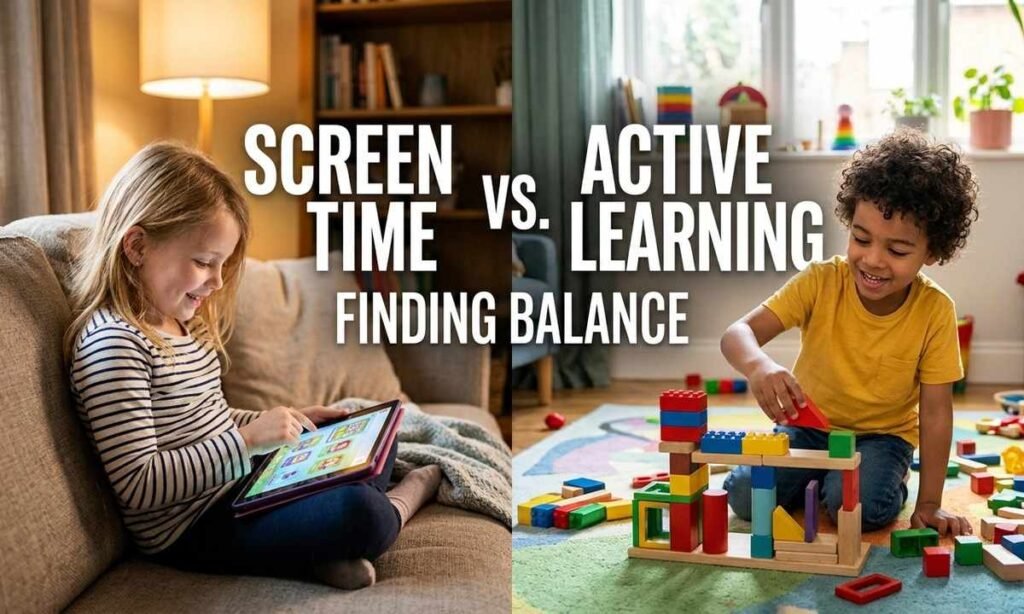
Screens are not the enemy, but they do not replace hands-on exploration. Problems tend to begin when screens crowd out play, sleep, movement and face-to-face talk. Balance, not total avoidance, is the realistic goal.
The American Academy of Pediatrics gives this general guidance for young children:
| Age | General guidance |
| Under 18 months | Avoid screens except video chats |
| 18 to 24 months | If used, choose high-quality content and watch together |
| 2 to 5 years | Up to about one hour a day of high-quality programs, with a parent watching |
| 6 and older | Set consistent limits so screens do not replace sleep, activity or family time |
The AAP also suggests keeping meals and bedrooms screen-free and avoiding screens for an hour before bed. These small boundaries protect sleep and family time.
Screens can support active learning when you use them together. Watch a short video about bridges, then build one from paper. Ask questions while a show plays. The more interesting the real world is, the less often a child asks for the tablet.
Set expectations before the screen goes on, not after. Agree on what will be watched and when it will end. A visual timer or a clear stopping point, such as the end of one episode, makes the switch back to play much easier.
How Active Learning Improves Creativity and Independent Thinking
Creativity grows when children have time, choices and permission to make a mess. Independence grows when they are trusted with small decisions. Both need a parent who is willing to let things get a little messy.
You can support both with simple habits:
- Offer two choices, such as which shirt to wear or which bowl to use
- Say “What else could we try?” instead of giving the answer
- Let children finish their own project, even if it looks odd
- Give open-ended materials, such as boxes and tape, rather than single-use toys
- Let them pour, dress and tidy on their own, even when it is slower
A child who is trusted with small tasks learns that their ideas matter. That belief is the base of independent thinking. It also makes children more willing to try new things.
When Active Learning Feels Like a Chore
If learning feels like one more item on your to-do list, the plan is too big. Active learning is not meant to add work. It is meant to change how you approach what you already do.
Try these resets:
- Pick one routine, such as dinner prep, and invite your child in
- Lower the bar. Five minutes counts
- Skip the activity if everyone is tired
- Reuse household items instead of buying kits
Signs you may be doing too much include planning activities daily, feeling guilty when you skip them and correcting your child often. Pull back, and let ordinary life do the teaching.
Remember that your child does not need you to be a teacher all day. Being present, curious and patient is enough. Rest is part of good parenting too.
The 10-Minute Rule for After-School Learning
The 10-minute rule is a simple habit, not a scientific law. When your child comes home, spend ten minutes of calm, undivided attention with them before anything else.
Here is how it works:
- Put your phone away and sit near your child.
- Let them choose what to share or play.
- Listen, comment and ask one curious question.
- Skip lessons, corrections and homework talk.
Many parents find that children who get this short burst of connection ask for less attention later. A child who feels seen is usually more willing to play on their own and explore.
Making Learning a Natural Part of Home Life
The goal of active learning fparentips is not an early reader or a perfect schedule. It is a home where curiosity feels normal and questions are welcome. Learning stays part of daily life instead of becoming a separate task.
This grows slowly through small repeated habits:
- Keep materials visible and within reach
- Talk with your child during routines, not just after them
- Read together and ask what might happen next
- Mix movement into the day with walks, dancing or garden jobs
- Treat mistakes as useful information
| Day | Everyday moment | Skill |
| Monday | Set the table | Counting |
| Wednesday | Sort laundry | Classifying |
| Friday | Build with boxes | Planning |
| Weekend | Cook together | Measuring |
This is only an example. Adjust it to fit your family. Some weeks will look different, and that is perfectly fine.
Conclusion
Active learning fparentips comes down to a simple idea: children learn best by doing, choosing and exploring. You do not need a special room, expensive toys or a rigid plan. Everyday moments in your home already offer plenty of hands-on learning. The key is noticing them and giving your child room to take part.
Start with one change, such as a kitchen job at 4:30 or a 10-minute check-in after school. Watch, wait and follow your child’s lead. Over time, those small habits build curiosity, problem-solving and confidence that last. Small steps taken consistently will matter far more than any perfect plan.
Frequently Asked Questions
What Is Active Learning for Parents?
Active learning means helping children learn by doing, choosing and exploring instead of only listening. Parents support it by watching, asking questions and letting kids try.
How Can I Start Active Learning at Home?
Start small by inviting your child into a daily task, such as setting the table or sorting laundry. Ask open questions and let them work it out.
What If My Child Refuses to Participate?
Offer a choice instead of a direction, and check for hunger, tiredness or a need for attention first. Try again later without pressure.
How Much Daily Time Does Active Learning Require?
It needs no fixed block of time. Ten minutes of child-led play or one shared task a day is a good start.
Can Screen Time Support Active Learning?
Yes, when content is high quality and you watch together. Ask questions and follow up with a hands-on activity.
What Does Fparentips Mean?
Fparentips is an informal online keyword for practical parenting tips. It is not an official educational term or program.
Why Are Blocks Better Than Worksheets?
Blocks let children plan, test and fix problems with instant feedback. Worksheets mostly practice recall of something already taught.