
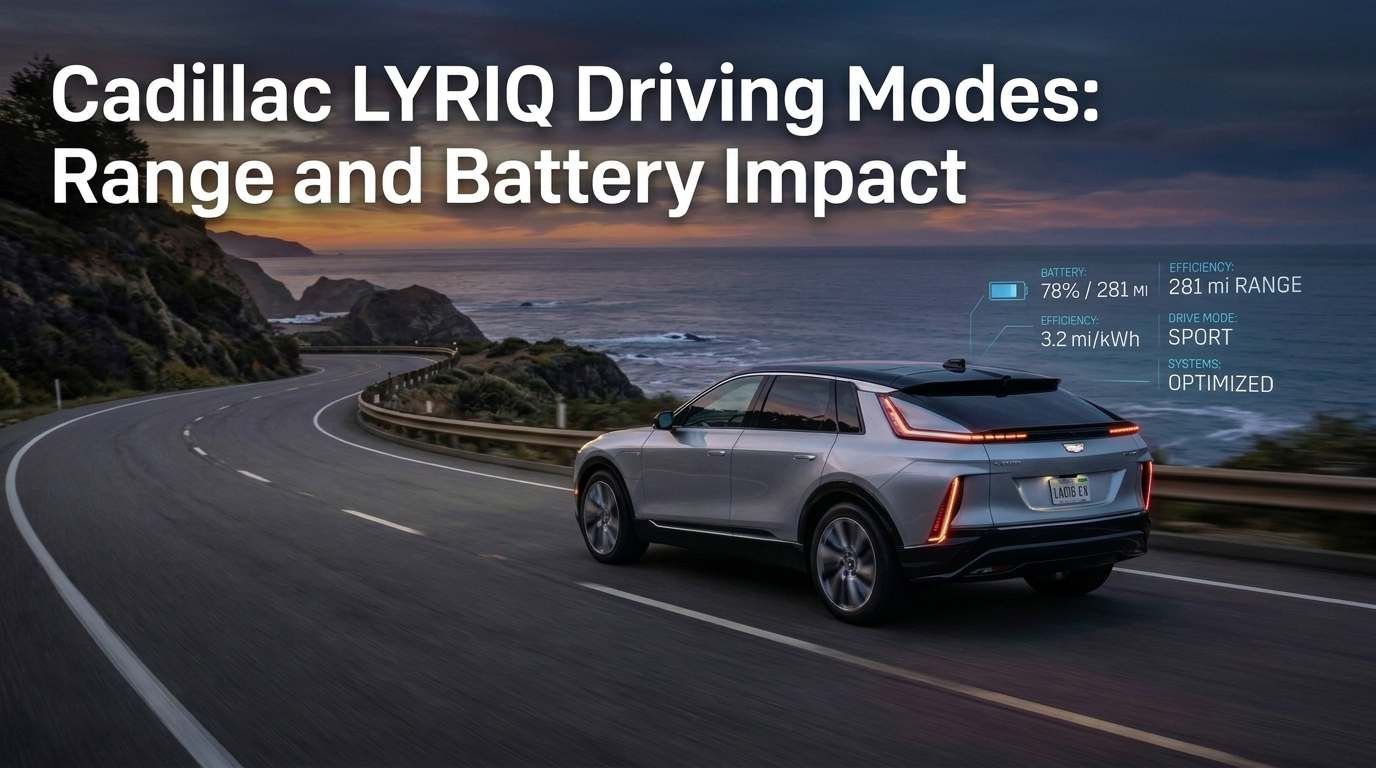
The Cadillac LYRIQ gives you four driving modes, and most owners wonder the same thing: does picking Sport instead of Tour quietly drain the battery faster? The short version is yes, but not through the battery itself. Each mode changes how the motors deliver power, how the steering and brakes feel, and how much energy you use per mile.
This guide explains what every mode does, how much range you can realistically gain or lose, and which setting suits daily driving. You will also find tips on regenerative braking, winter range, charging habits and long-term battery health, so you can get the most from your 2026 LYRIQ, whether you drive in a busy city, on open highways or in snowy hills.
Quick Answer: Do LYRIQ Drive Modes Change Driving Range?
Yes. Drive modes change real-world range, but they do not change the battery size or the official EPA rating. Tour mode is the most efficient setting. Sport uses more energy because of sharper throttle response, while Snow/Ice and My Mode fall somewhere in between depending on conditions and settings.
Switching modes never locks away part of the pack. The full 102 kWh battery stays available in every mode. What changes is how quickly you spend that energy, which is why two drivers with the same car can see very different range numbers on the same road.
2026 Cadillac LYRIQ Range and Battery Specifications
The 2026 LYRIQ uses a 102 kWh battery pack across the lineup, and the EPA range depends on the trim and drivetrain. Rear-wheel-drive models sit at the top, all-wheel-drive versions give up a little range for traction, and the performance-focused LYRIQ-V trades distance for power. These are the figures worth knowing before comparing modes.
| Specification | 2026 Cadillac LYRIQ |
| Battery capacity | 102 kWh |
| EPA range, RWD | 326 miles |
| EPA range, AWD | 319 miles |
| EPA range, LYRIQ-V | 285 miles |
| Maximum DC fast charging | Up to 190 kW |
| Level 2 charge time (240V) | About 11.2 hours |
| Curb weight | Roughly 5,600 to 5,990 lbs, depending on trim |
| Battery warranty | 8 years or 100,000 miles |
Exploring the Cadillac LYRIQ’s Driving Modes
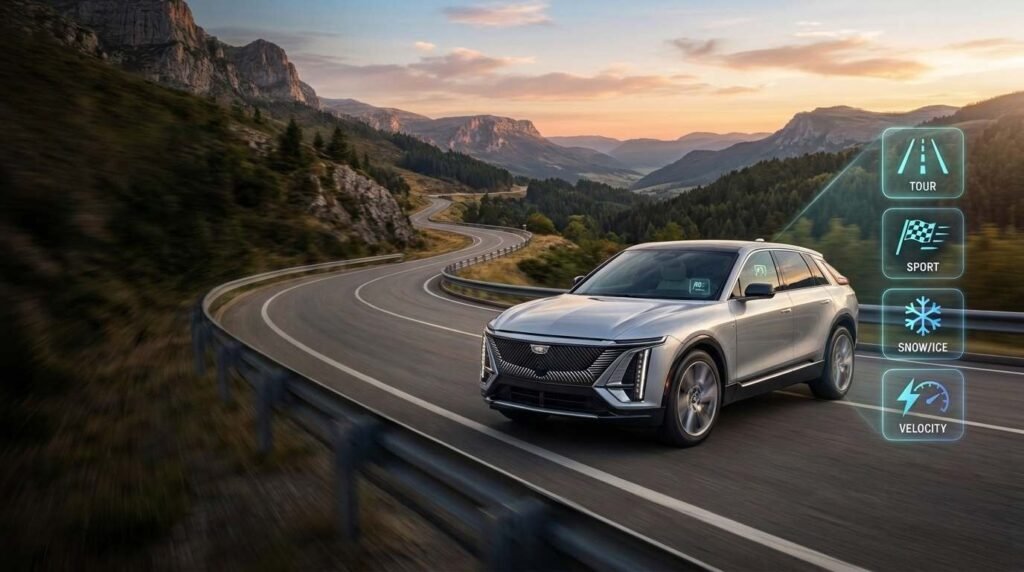
Cadillac offers four selectable modes: Tour, Sport, Snow/Ice and My Mode. Tour is the default every time you start the car. Each one adjusts pedal response, steering weight and traction logic, and the choice you make quietly shapes how far a charge will take you.
Tour Mode
Tour is the everyday setting and the one Cadillac treats as the baseline. Throttle response is smooth rather than sudden, steering stays light and the ride is comfortable for commuting, errands and long highway stretches. Because it avoids aggressive power delivery, it is generally the mode that stretches a charge the furthest.
Sport Mode
Sport sharpens the car’s reactions. The accelerator becomes more eager, the steering feels firmer and the whole vehicle feels more alert when you ask for power. It is fun on a clear on-ramp or a winding road, and it makes passing slower traffic feel effortless.
The trade-off is energy. Quicker acceleration pulls more power from the pack in short bursts, and if you drive like that for a whole trip, the range estimate falls noticeably faster than it does in Tour.
Snow/Ice Mode
Snow/Ice is built for slippery roads. It softens throttle input and adjusts traction control so the wheels are less likely to spin when grip is poor. On an AWD model, it also helps the car distribute power more carefully between the axles.
My Mode
My Mode lets you build your own combination. You can mix settings for steering, braking feel, throttle character and even the simulated motor sound, so the car behaves exactly the way you like. It is the closest thing to a personal profile.
How Each Driving Mode Affects Battery Consumption and Range
A driving mode does not add or remove battery capacity. It changes the way the car responds to your foot, and therefore how much energy leaves the pack each mile. Think of it as the difference between gentle and hard acceleration in any vehicle, only more noticeable because electric motors deliver torque instantly.
Tour Mode and Energy Efficiency
Tour keeps power delivery smooth and predictable, which means fewer sudden spikes in energy use. Combined with the stronger regenerative braking many drivers pair with it, this mode usually returns the best efficiency in city and mixed driving. It encourages the kind of steady driving that EVs reward.
Sport Mode and Increased Energy Consumption
Sport raises energy use because the motors respond more aggressively to the accelerator. Even if you are not flooring it, the same pedal position produces more power than it would in Tour. Over a long drive, that adds up to a visible drop in range.
Snow/Ice Mode and Battery Efficiency
Snow/Ice itself uses only slightly more energy because of the added traction management. The bigger range hit comes from the conditions you are using it in. Cold air thickens, heated seats and cabin heat draw power, and winter tires add rolling resistance.
My Mode and Its Effect on Battery Usage
My Mode has no fixed energy profile, since you decide what goes into it. Choose softer throttle and standard steering, and efficiency stays close to Tour. Choose sharper throttle and heavier braking feel, and consumption moves toward Sport.
Measuring the Range Differences Across Driving Modes
Cadillac and the EPA publish a single range number per trim, not one for each mode, so the differences below are practical estimates based on how EVs typically behave. They are not official figures, and they use the 326-mile rear-wheel-drive rating as the starting point. Your own results will depend on speed, weather, load and driving style.
Tour Mode Range
In Tour, a rear-wheel-drive LYRIQ can come close to its rated distance when you drive gently in mild weather. Many owners should expect something around 290 to 320 miles in mixed use. City driving with regenerative braking can push the figure higher, while fast highway driving pulls it lower.
Sport Mode Range
Sport commonly trims range by roughly 5 to 10 percent if you drive it the way the mode invites. That puts a rear-wheel-drive car at about 260 to 295 miles in mixed driving. Gentler use will narrow the gap, and constant hard acceleration can widen it.
Snow/Ice Mode Range
Snow/Ice by itself costs only a small amount of range, but the winter setting changes everything around it. In cold weather, a total range of about 250 to 290 miles is realistic for a rear-wheel-drive model, depending on temperature, cabin heat and tire choice. Preconditioning while plugged in helps recover some of that loss.
My Mode Range
My Mode can land anywhere between the Tour and Sport figures, so roughly 260 to 320 miles is a sensible span. A mild personal setup stays near the top of that range. A performance-heavy setup moves you toward the bottom.
Cadillac LYRIQ Driving Modes: Range Comparison
This side-by-side view shows how each mode fits different situations. The range figures are estimates for a rear-wheel-drive LYRIQ in mixed driving, not official Cadillac data.
| Mode | Best For | Energy Use | Estimated Range (RWD) |
| Tour | Daily commuting, road trips, city driving | Lowest | 290 to 320 miles |
| Sport | Spirited driving, quick merging | Highest | 260 to 295 miles |
| Snow/Ice | Snow, ice and slippery roads | Slightly higher, plus cold effects | 250 to 290 miles |
| My Mode | Custom comfort and handling | Varies with settings | 260 to 320 miles |
Which Cadillac LYRIQ Driving Mode Is Best for Everyday Efficiency?
Tour is the best driving mode for everyday efficiency. It is the default for a reason: it balances comfort, control and energy use better than the others, and it rewards smooth driving that stretches range. For commuting, school runs and highway trips, there is little reason to leave it. Real-World Factors to Consider When Choosing a Driving Mode
The best mode depends on more than the setting itself. Road surface, weather, the length of your trip and how much charging is available all matter. A mode that makes sense on a dry morning commute may be the wrong call on a snowy night drive.
Before picking a mode, run through these quick checks:
- Road condition: Use Snow/Ice only when grip is genuinely low.
- Trip length: Stay on Tour when the distance to your next charger is close to your remaining range.
- Weather: Cold and wind matter more than the mode, so plan an extra buffer.
- Passengers and cargo: A heavier load uses more energy in every mode.
- Charging access: If a fast charger is nearby, you can afford a bit more fun.
How Regenerative Braking and One-Pedal Driving Improve Range
Regenerative braking turns the motors into generators when you slow down, sending energy back to the battery instead of wasting it as heat. On a vehicle that weighs well over 5,000 pounds, that recovered energy makes a real difference. Cadillac gives you two ways to control it, and both work alongside the drive modes.
How Regenerative Braking Helps Recover Energy
Every time you lift off the accelerator or press the Regen on Demand paddle on the steering wheel, the car recovers some of the energy it would otherwise lose. The paddle is pressure sensitive, so a harder squeeze slows the car more and sends more energy back to the pack.
Regeneration is not unlimited. Cadillac notes that performance can be reduced when the battery is cold or close to full, so you may feel weaker regen on a frosty morning or just after a 100 percent charge.
One-Pedal Driving in City and Highway Conditions
One-pedal driving lets you speed up and slow down using only the accelerator, and it is available in any drive mode. In the city, it is excellent for traffic and downhill roads because you recover energy almost constantly without touching the brake pedal.
How Driving Conditions Influence LYRIQ Range
Where and how you drive often matters more than the mode you pick. The same LYRIQ can return very different numbers in a crowded downtown, on an interstate or across a mountain pass, so it helps to understand what each setting does to efficiency.
Range During City Driving
City driving is usually kind to an EV. Lower speeds mean less wind resistance, and frequent braking gives regenerative braking plenty of chances to recover energy. That is why efficiency often looks better in town than on a highway.
Range During Highway Driving
Highway driving is where range falls fastest, because air resistance climbs sharply as speed goes up. Driving at 75 mph uses clearly more energy than driving at 65, and the difference is bigger than most people expect.
Here the drive mode matters less than your speed. Cruising in Tour at a moderate pace will normally beat Sport at a higher pace by a wide margin, and cruise control helps keep consumption steady.
Driving in Mountains and High-Elevation Areas
Climbing hills takes a lot of energy, because the motors work against gravity and the car’s weight. Expect a clear drop in range on long uphill stretches, even in Tour mode, as the display falls faster than the miles you cover.
Other Factors That Influence LYRIQ Range and Battery Consumption
Drive modes are only one part of the picture. Several other variables can add or subtract more range than the difference between Tour and Sport, and they stack together on real trips.
Driving Habits and Their Impact on Efficiency
Smooth inputs save energy. Gentle acceleration, early lifting off the pedal and steady speeds all cut consumption, while rapid starts and late braking waste it. A calm driver in Sport can sometimes beat a hurried driver in a Tour.
Vehicle Speed and Highway Conditions
Speed is the single biggest controllable factor on the highway. Wind resistance rises quickly as you go faster, so every extra mile per hour costs more energy than the one before it.
Weather and Temperature Effects
Cold weather reduces range for two reasons: the battery is less efficient when chilly, and heating the cabin takes energy. In deep winter, many EVs lose a noticeable share of their range, and the LYRIQ is no exception.
Terrain and Elevation Changes
Elevation matters because gaining height costs energy, while losing it returns some. A route with long climbs can use far more energy than a flat route of the same distance.
Tips to Maximize Your Cadillac LYRIQ’s Driving Range
A few simple habits can add noticeable miles without changing how you enjoy the car. Start with the ones that cost nothing, then add the rest as they fit your routine.
- Stay in Tour mode for daily driving and long trips.
- Use one-pedal driving or Regen on Demand in traffic to recover energy.
- Drive at moderate highway speeds and use cruise control.
- Precondition the cabin and battery while the car is still plugged in.
- Keep tires properly inflated, since low pressure raises rolling resistance.
- Remove roof racks and extra cargo when you do not need them.
- Use heated seats and the steering wheel instead of blasting cabin heat in cold weather.
- Plan charging stops so you arrive with a healthy buffer rather than a nearly empty pack.
Can Driving Modes Affect LYRIQ Battery Health?
Driving modes do not damage the battery on their own. Using Sport occasionally is perfectly fine, and the battery management system protects the pack from unsafe conditions. What matters for long-term health is how the battery is charged, stored and used over time, not which mode you chose last Tuesday.
That said, constant hard acceleration and frequent fast charging create more heat and stress than gentle use. If you are in Sport mode all the time and also rely on DC fast charging, you may see slightly faster aging than someone who drives calmly and charges slowly at home. The difference is gradual, but it is real.
Best Practices for Maintaining Long-Term Battery Health
Battery health depends mostly on charging habits and temperature. The following routines are widely recommended for lithium-ion packs and fit the LYRIQ well.
Recommended Charging Habits
For daily use, set a charge limit around 80 percent and keep the battery between roughly 20 and 80 percent. Charge to 100 percent only when you need the full range for a trip, and avoid leaving the car sitting at full or empty for long periods.
Level 2 charging at home or work is gentler than frequent DC fast charging. Save fast charging for road trips, and if the car will be parked for weeks, leave it near the middle of the charge range.
The Importance of Battery Preconditioning
Preconditioning warms or cools the pack before you drive or fast charge, so the battery operates in a comfortable temperature range. The LYRIQ can begin preconditioning automatically when you set a route to a charging station, and you can also start it manually.
Routine Battery and Vehicle Maintenance
Keep the software updated, check tire pressure regularly and follow the service schedule in your owner’s manual. Cadillac covers the high-voltage battery with an 8-year or 100,000-mile limited warranty, which adds peace of mind.
If you notice a sudden or unusual drop in range, a warning message or slow charging, have it inspected rather than waiting. Early diagnosis is cheaper and can protect both the pack and your warranty coverage.
Common Myths About LYRIQ Driving Modes and Battery Performance
A lot of confusion circulates among new EV owners. These are the most common mix-ups, along with what is actually true.
- Myth: Sport mode uses a bigger part of the battery. The full pack is available in every mode. Sport only changes how fast you use it.
- Myth: Tour mode limits power. Tour still delivers plenty of performance for daily driving. It simply responds more smoothly.
- Myth: Snow/Ice mode is only for winter. It is for slippery surfaces, which can happen in rain or on gravel too.
- Myth: Driving modes wear out the battery. Modes do not harm the pack. Charging habits and heat matter far more.
- Myth: One-pedal driving is always more efficient. It helps most in traffic and on hills, but smooth driving matters just as much.
EPA-Estimated vs. Real-World Cadillac LYRIQ Range: Key Differences
The EPA number comes from standardized lab testing designed to compare vehicles fairly, not to predict your exact trip. Real roads add wind, hills, traffic, passengers, accessories and temperature swings, so your result will usually differ from the sticker. Some drivers beat it in gentle city use, while many fall short on fast highways or in winter.
| Factor | EPA Testing | Real-World Driving |
| Speed | Standardized cycles | Varies, often higher on highways |
| Temperature | Controlled conditions | Heat and cold both change range |
| Terrain | Mostly flat | Hills and elevation changes |
| Driving style | Consistent, mild | Personal, sometimes aggressive |
| Accessories | Limited use | Heater, A/C and heated seats |
| Drive mode | Not separated by mode | Tour, Sport and others change results |
Conclusion
The Cadillac LYRIQ’s driving modes change how efficiently the car uses its 102 kWh battery, even though they never change the size of the pack. Tour is the best choice for everyday range, Sport trades efficiency for excitement, Snow/Ice prioritizes safety and My Mode depends on your settings.
If you want the most distance, drive smoothly, use regenerative braking, watch your speed and charge sensibly. Combine those habits with preconditioning and an 80 percent daily charge limit, and the LYRIQ can deliver strong range for years while keeping its battery healthy.
Frequently Asked Questions
Should You Charge Your Cadillac LYRIQ to 100%?
Only when you need maximum range for a trip. For daily driving, charging to about 80 percent is gentler on the battery.
Can You Change Driving Modes While the LYRIQ Is in Motion?
Yes, the mode selector can be used while driving, but it is safest to change when conditions are calm or the car is stopped.
What Are the Main Disadvantages of the Cadillac LYRIQ?
The main drawbacks are the high price, heavy weight, a complicated infotainment system and range loss in cold or fast highway driving.
What Is the Expected Lifespan of a Cadillac LYRIQ Battery in Miles?
The battery is warrantied for 100,000 miles, and with good care many packs should last well beyond that, often 150,000 miles or more.