
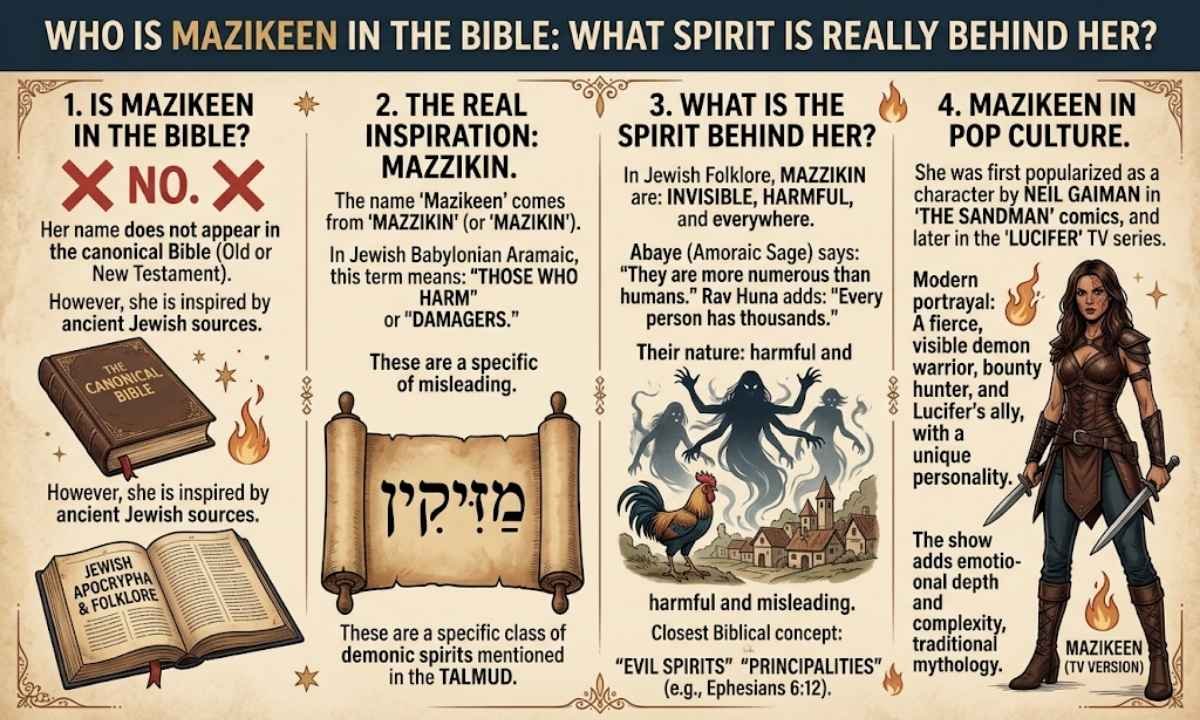
If you have ever paused a Lucifer episode to Google “is Mazikeen in the Bible,” you are not alone 👀. Her name sounds ancient, her energy feels biblical, and her whole vibe screams “this has to be real folklore.”
Here is the honest answer. Mazikeen in the Bible does not exist as a named character anywhere in scripture. But the spirits she is named after are very real, and their story is stranger and older than most fans realize.
Is Mazikeen a Real Demon?
Short answer? No, not as a single named demon with her own biblical file. Mazikeen in the Bible is a myth built on a real foundation, which is honestly the best kind of lore, since it means the story did not come from nowhere.
The character called Mazikeen was created by writer Neil Gaiman for DC Comics in 1990. She first appeared in The Sandman #22, drawn as a demon with a half skeletal face and zero patience for nonsense. Gaiman did not pull the name out of thin air though. He borrowed it from an actual Hebrew and Aramaic term used in Jewish demonology for centuries before comic books existed.
So while there is no verse anywhere that mentions a demon named Mazikeen directly, the class of spirits her name comes from shows up again and again in rabbinic writing. That distinction matters a lot if you are trying to separate scripture from pop culture 🔍, because the internet loves to blur the two together.
Here is the simple breakdown people usually search for:
- Mazikeen the individual character: fictional, invented in 1990 by Gaiman
- Mazikin the category of spirits: documented across Talmudic literature
- Mazikeen in the Bible directly: not mentioned anywhere in scripture at all
That third point is the one most fan pages skip, and it is the one that actually answers the question people are typing into Google late at night. It is also why so many “biblical demon” listicles get this character wrong from the very first line.
Part of the confusion comes from how modern shows and comics are marketed. Lucifer itself is described as loosely inspired by biblical mythology, and that loose framing gets flattened online into “this show is based on the Bible,” which then gets applied to every character in it, including Maze. In reality, the show borrows names and ideas from scripture, folklore, and pure invention all at once, mixing them together in a way that makes it genuinely hard to tell where one ends and another begins without doing the research yourself.
This is not a criticism of the writers either. Blending real mythology with invented detail is a storytelling tradition that goes back centuries, long before television existed.
What matters for anyone actually curious about Mazikeen in the Bible is being able to separate the entertainment layer from the historical layer, and that is exactly what the rest of this article walks through, section by section.
What the Talmud Says About Mazikin?
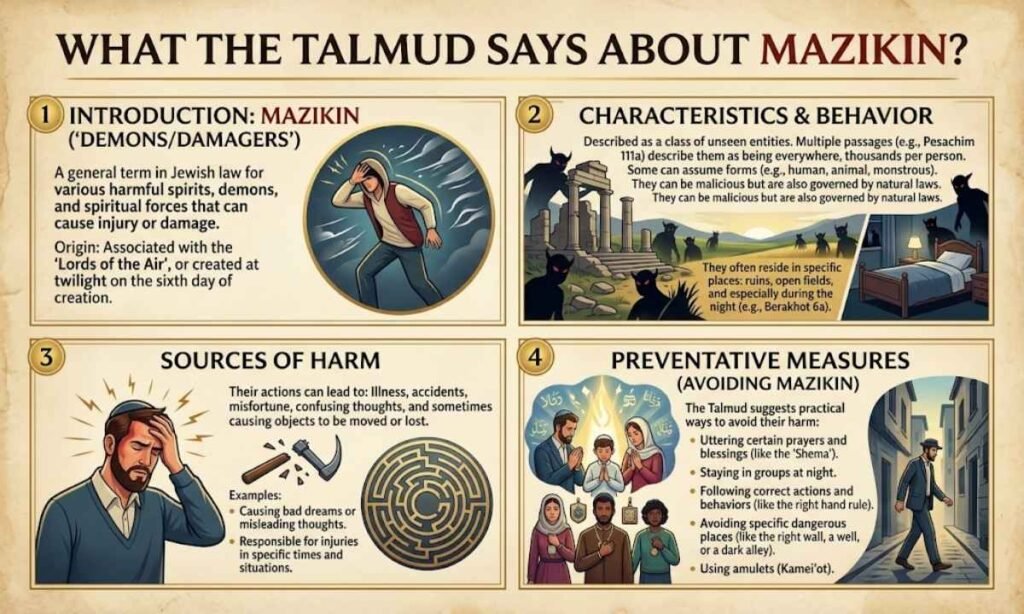
The word mazikin comes from the Hebrew root “mazik,” meaning one who harms or damages. In the Talmud, mazikin (also spelled mazzikim or mazzikin) are described as invisible entities capable of causing anything from minor annoyance to genuine danger, depending on the passage and the rabbi doing the interpreting.
According to Jewish tradition, demons were created on the sixth day, right before the Sabbath began, which is why some rabbis describe them as unfinished beings.
Certain rabbinic sources connect this idea to Pirkei Avot, where a handful of spiritual creations are said to have formed in the twilight hours right before God rested from creation.
The Talmud describes mazikin as sharing traits with both humans and angels. They could reportedly eat and drink like people, yet move unseen like purely spiritual beings, existing in a strange middle ground the rabbis found genuinely fascinating to debate.
Certain passages even describe folk methods people supposedly used to detect them, like scattering fine ash around a bed to look for tiny rooster like footprints in the morning.
Mazikin were not always framed as purely evil either. Some texts describe them as operating under divine permission, almost like enforcers rather than independent villains acting on their own agenda.
That single detail is a huge reason the Mazikeen in the Bible search trend keeps climbing, because people assume “demon mentioned in Jewish scripture” automatically means “demon mentioned in the Bible.” Those are two very different libraries of text, written centuries apart, for very different purposes.
Some Talmudic tractates also describe mazikin as being drawn to specific locations, including ruins, gutters, and places where water pooled after rain. This connects to a broader ancient belief that harm was not random but tied to certain unclean or neglected spaces, a theme that echoes across several ancient Near Eastern cultures, not just Jewish tradition alone.
It is worth noting that Judaism, as a whole, does not center demonology the way some other traditions do. Evil spirits are rarely treated as an independent force capable of challenging God directly.
Instead, mazikin and similar entities are generally seen as minor, sometimes even mischievous, operating within limits rather than running wild across creation. This is a very different picture from the horror movie version of demons most modern audiences grew up watching, and it is one of the biggest gaps between the source folklore and the fictional Mazikeen in the Bible search trend online.
Later texts from the Geonic period, roughly the sixth through eleventh centuries, show communities using incantation bowls buried under homes to protect against mazikin and related spirits like shedim and lilin.
Archaeologists have actually recovered many of these bowls, inscribed with Aramaic spells in a spiral pattern, giving historians real physical evidence that belief in these spirits was not just literary but part of everyday practice for ordinary families.
| Term | Meaning | Primary Source |
| Mazikin | Harmful, invisible spirits | Babylonian Talmud |
| Shedim | Foreign spirits linked to false worship | Deuteronomy 32:17 |
| Lilin | Night spirits associated with Lilith | Jewish folklore |
| Ruchin | General category of spirits or winds | Rabbinic literature |
Mazikeen Mythology
Origins in Jewish Folklore
Jewish folklore treats mazikin as part of everyday spiritual life rather than distant end times villains reserved for prophecy. People believed these spirits lingered near ruins, under gutters, or in dark corners of a home.
They were less about apocalyptic evil and more about the small, irritating dangers of daily existence, like a bad fall down the stairs, a spoiled meal, or an illness nobody could explain at the time.
This everyday framing is actually what makes mazikin so different from the grand, world ending demons people expect from horror movies. They were domestic threats, woven into ordinary superstition the same way a black cat crossing your path became a warning sign in other cultures.
The Folklore Story
One recurring folk method for detecting mazikin involved burning the ashes of a black cat’s fur, specifically one born to a firstborn black cat, and placing the ash near the eyes to supposedly “see” the spirits moving around a room.
Whether or not anyone actually tried this ritual is beside the point. The story survived because it captured something universal, the fear of harm you cannot see coming until it is already happening.
Other tales describe mazikin gathering in abandoned buildings at night, which is likely why so many ruins across the ancient Near East carried a reputation for being cursed or haunted long after their original purpose faded away.
These folk stories were passed down orally for generations before ever being written into formal commentary, which means the version that survived in the Talmud is likely just one thread of a much larger oral tradition that never made it onto a page.
That gap is part of why modern retellings, including Mazikeen in the Bible search results online, feel incomplete no matter how much research you do, because so much of the original material simply was not preserved.
Understanding the Origin of the Name Mazikeen
The name breaks down cleanly once you know the Hebrew roots involved. “Mazik” means one who harms or damages, a fairly blunt and functional word choice.
Add the plural ending and you get “mazikin,” the harmful ones, a term that shows up consistently across different rabbinic texts and time periods.
Neil Gaiman anglicized this into “Mazikeen” for his character, giving her a name that sounds personal and ancient at the same time, almost like a real historical figure rather than an invented one.
This is actually a smart writing move on Gaiman’s part. Instead of inventing a random demon name from scratch, he tied his character to centuries of real folklore, which instantly gave her weight without needing pages of exposition to explain who she was.
That is also exactly why so many readers assume she must be biblical. T
he name simply sounds like it belongs in an old text 📖, and the sound of a word can carry almost as much authority as its actual meaning when you are scrolling through a comic panel or a streaming episode.
Linguists who study Hebrew and Aramaic naming patterns point out that Gaiman’s choice was unusually precise for a comic writer working in the late 1980s. Rather than softening the harsh consonants of “mazikin” into something more marketable, he kept the core sound almost entirely intact, only adding the “een” ending to make it read as a proper first name rather than a category label.
That small adjustment is the entire difference between “a class of spirits” and “a specific character with her own personality,” and it is a detail that gets lost every time someone shortens the research down to a quick internet search.
Cultural and Spiritual Significance of the Name Mazikeen
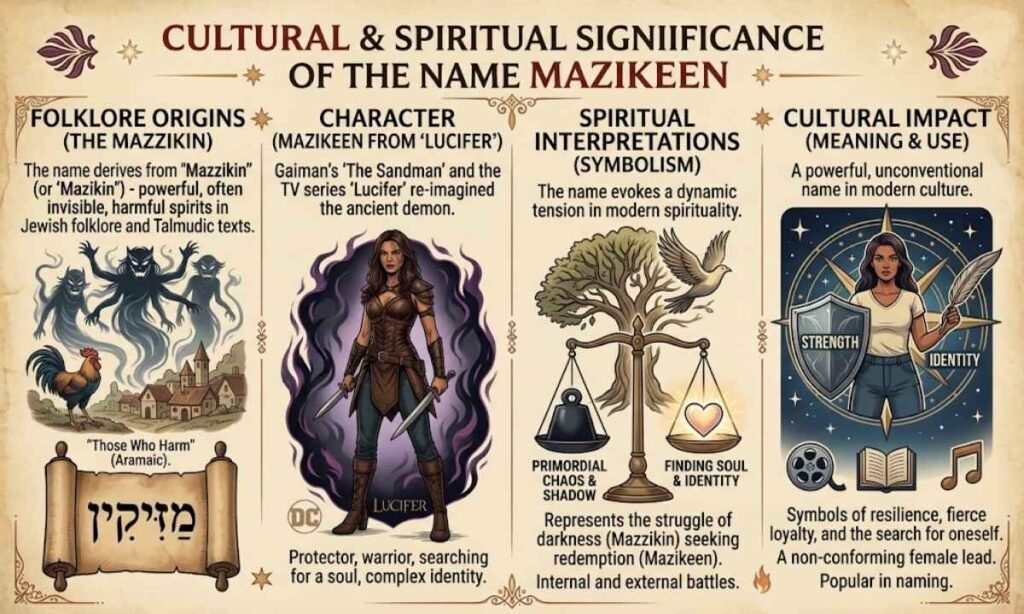
In Jewish mystical thought, names were never just labels used for convenience. Knowing a spirit’s true name was believed to give a person power or protection over it, a concept that appears repeatedly across Kabbalistic writing and older folk magic traditions alike.
That idea of “the name matters” is not unique to Jewish mysticism either, and it shows up in surprisingly similar forms across other religious traditions. Christianity carries a version of this same principle, just pointed in a very different direction. Philippians 2:10 says that at the name of Jesus, every knee will bow, in heaven, on earth, and under the earth. No folkloric spirit, fictional or real, operates outside that authority in Christian belief, regardless of how ancient or culturally significant its origin story sounds.
So even though Mazikeen in the Bible is not a literal search result you will find in scripture, the underlying concept of a name carrying real spiritual weight absolutely is biblical, which is probably why the phrase feels so believable to so many people at first glance.
This kind of naming power also shows up in other biblical moments outside Philippians. Genesis describes Adam naming the animals as an act tied to authority over them. Later, several figures in scripture receive new names at pivotal spiritual moments, Abram becoming Abraham, Jacob becoming Israel, each shift marking a change in identity and purpose.
Placing Mazikeen’s fictional naming story next to these real biblical patterns is not an attempt to equate the two directly. It is simply a way of showing why the idea of “a name that means something” lands so naturally with audiences who already carry these deeper cultural associations, even if they could not point to the exact verse.
Who Is Mazikeen in Sandman?
In Neil Gaiman’s Sandman universe, Mazikeen is Lucifer Morningstar’s loyal companion and one of the Lilim, a race said to descend from Lilith. She is fierce, fiercely protective of her own space, and physically marked by a half destroyed face that she treats as identity rather than injury or shame.
Comic Mazikeen predates the TV version by decades. She debuted in 1990 and later became a recurring figure across multiple DC and Vertigo titles connected to the wider Lucifer mythos, appearing alongside characters most casual TV fans have never even heard of.
Her comic version tends to be quieter and more calculating compared to the sharper, more sarcastic TV portrayal fans know from streaming platforms today.
Readers who only know the Netflix version are often surprised by how different her comic dynamic with Lucifer actually feels. The page version leans into political intrigue within Hell’s hierarchy, while the screen version leans into found family and personal growth on Earth.
Gaiman’s original run also treats her less as comic relief and more as a genuine warrior figure, someone who commanded respect among the Lilim long before she ever set foot on Earth. That warrior background carried over into her spinoff appearances in Mike Carey’s Lucifer comic series, where she gets even more room to develop outside of being purely a supporting character to the devil himself.
What Kind of Demon Is Mazikeen in the Bible?
Technically, none. Mazikeen in the Bible is not a category the text supports, since the Bible itself never uses that name or that specific classification system anywhere in its pages, Old or New Testament alike.
What the Bible does contain are broader references to spiritual beings that later folklore expanded into figures like the mazikin.
This is a common pattern across religious history, where a handful of vague scriptural references grow into detailed folk traditions over hundreds of years of retelling and reinterpretation.
Closest Biblical Parallels
The nearest biblical cousin to mazikin is the term “shedim,” found in Deuteronomy 32:17, where it describes spirits tied to false worship and idolatry.
Shedim are not identical to mazikin, but both concepts feed into later Jewish demonology, and both get flattened into a generic “biblical demon” label by pop culture searches that are not being precise with their sources or their timelines.
Some scholars also point to Psalm 91, which references a “terror by night” and a “pestilence that stalks in darkness,” as another possible root for later spirit related folklore, even though the psalm itself is widely understood as poetic imagery about protection rather than a literal demon catalog. Stretching these poetic verses into direct evidence for mazikin, or for Mazikeen in the Bible specifically, is exactly the kind of overreach careful readers should watch out for when researching this topic online.
Mazikeen of Lilith
Both on screen and in the comics, Mazikeen is described as one of Lilith’s children, part of a wider group called the Lilim. Lilith herself is not named in the Bible directly, though she appears in later Jewish folklore as Adam’s first wife, a figure who refused submission and became associated with night spirits and independence from patriarchal expectations.
This lineage is a big reason fans conflate Mazikeen in the Bible with actual scripture. Lilith adjacent characters already carry a “borrowed from religion” feel, so audiences assume the daughter figure must be scriptural too, when really she is folklore built on folklore, two full layers removed from the actual biblical text itself, with pop culture adding a third layer on top.
Lilith’s own story comes primarily from the Alphabet of Ben Sira, a medieval Jewish text, rather than from Genesis directly. Genesis simply describes one creation account of humanity without naming a first wife before Eve. Later folk tradition filled that gap with Lilith, and the Lilim, including Mazikeen, exist entirely within that later, extra biblical layer of storytelling, several centuries removed from the original scriptural text.
Who Is the Father of Mazikeen?
In the Lucifer comics, Mazikeen’s father is identified as Ophur, a serpent demon with his own small corner of lore within the wider mythos. The TV series never names her father at all, leaving that detail exclusive to comic canon and a frequent point of confusion for fans who only watched the show.
This is a small but frequently searched detail, since fans want the full family tree once they learn who her mother is. It also highlights how much material the comics contain that never made it to screen, since television adaptations almost always trim side characters for time.
Her Relationship with Lucifer
Loyal Demon
Across both comics and TV, Mazikeen is consistently framed as Lucifer’s most trusted ally. She followed him out of Hell and stood by him through centuries of complicated choices, which is a rare kind of loyalty even by demon standards, let alone human ones.
Loyalty in her case is never framed as blind obedience either. Across the show’s later seasons, Maze repeatedly questions Lucifer’s choices, calls him out directly, and even threatens to leave when their goals stop lining up.
That willingness to push back is part of what separates her from a typical sidekick character, since real loyalty in her world always comes with honesty attached.
Strong and Independent Woman
Modern audiences, especially younger viewers, latched onto Mazikeen because she refuses to be defined by anyone else’s expectations.
She sets boundaries, walks away from toxic dynamics, and chooses her own path even when it means leaving Lucifer’s side entirely 💪, a decision the show treats as growth rather than betrayal.
This arc plays out most clearly in her relationship with Eve, where Maze has to figure out what she actually wants from a partner rather than what centuries of conditioning in Hell trained her to accept.
Watching a demon character work through modern relationship boundaries is part of what made her feel so relatable to a generation raised on conversations about self worth and emotional honesty.
Complexities of Existence
Maze’s arc across the TV series deals with abandonment, identity, and what it means to build a life on Earth after being raised purely to torture souls in Hell.
That emotional depth is a huge reason she resonates far beyond typical “sidekick demon” territory, turning her into one of the show’s most discussed characters online.
Her found family with Linda Martin and Trixie Espinoza also becomes central to this arc, giving her the kind of unconditional support she never had growing up among the Lilim.
By the show’s final season, Maze is no longer defined purely by her demon nature or her connection to Lucifer, but by the relationships she chose for herself along the way.
Mazikeen Demon Face
What Happened to Mazikeen’s Face?
In the comics, her half skeletal face is simply part of her Lilim biology, not the result of an attack or a punishment handed down by anyone. She wears it proudly and resists any attempt by others to “fix” her appearance, treating it as identity rather than damage that needs correcting.
The TV series softened this visual for practical filming reasons, giving Maze a more conventionally human look with only occasional demon face reveals during intense emotional or combat scenes.
Fans often debate which version hits harder, the comic’s constant reminder of what she is, or the show’s rarer, more shocking glimpses of it.
The show’s makeup team has spoken in interviews about deliberately saving the full demon face reveal for moments of real emotional stakes rather than casual scenes, treating it almost like a dramatic tool rather than a default appearance.
That choice mirrors the comic’s own logic in a way, since even Gaiman’s version uses her exposed skeleton as a symbol of unfiltered honesty rather than pure horror imagery.
The Bigger Picture: Mazikeen’s Cultural Impact
Why She Resonates
Mazikeen became one of the most quoted, most gif’d characters from Lucifer because she says exactly what she means, no filter, no apology, and no interest in softening the truth for anyone’s comfort. In an era where audiences are exhausted by characters who exist only to please others, Maze felt genuinely refreshing to watch week after week.
Themes She Embodies
She represents chosen family over blood family, self worth outside of usefulness to others, and healing that does not require becoming softer or smaller to be accepted. Those themes travel well on social media, which is exactly why her quotes still circulate years after the show ended 🔥, popping up in caption screenshots long after the final season aired.
There is also something deeper going on with how audiences discuss the Mazikeen in the Bible question itself.
For a lot of younger viewers, digging into whether a character is “real” folklore versus pure invention has become its own form of engagement, almost like a mini research project sparked by a favorite show.
That curiosity is genuinely a good thing, since it sends people toward actual historical and religious texts they might never have opened otherwise, even if the initial spark came from a streaming binge session rather than a classroom.
Mazikeen vs Maze: Comic Book Differences Explained
Comic readers and TV fans often argue about which version is “the real one,” but both are valid within their own separate canon, built for different mediums and different audiences. The comic version leans more mythic and mysterious, tied closely to Lilim politics and Hell’s internal power structure across multiple story arcs.
The TV version, nicknamed Maze, is more grounded, sarcastic, and emotionally arc driven, built for a six season character journey rather than a handful of comic appearances scattered across different titles. Neither version cancels the other out, and most longtime fans end up appreciating both for what they bring to the table.
New readers jumping into the comics after finishing the show often expect a familiar experience and are surprised by how much darker and more mythologically dense the source material actually is. There is less humor, fewer pop culture references, and a much heavier emphasis on Hell’s internal politics, which makes sense given the comics were written for an older Vertigo audience rather than a broad network television crowd.
| Feature | Comic Mazikeen | TV Mazikeen (Maze) |
| First appearance | The Sandman #22, 1990 | Lucifer pilot, 2016 |
| Father | Ophur, a serpent demon | Not named |
| Face | Naturally half skeletal | Mostly human, shifts during intense moments |
| Personality | Quiet, calculating | Blunt, sarcastic, emotionally driven |
| Role | Lilim war leader | Bartender, bounty hunter, Lucifer’s ally |
Mazikeen Pronunciation and Meaning Breakdown
People searching “Mazikeen pronunciation” usually land on “MAH zih keen,” with the stress placed on the first syllable rather than the middle one. It comes directly from the Hebrew and Aramaic “mazikin,” so saying it closer to the original gives you a small edge of folklore credibility at your next trivia night 😄.
Understanding the pronunciation also helps clear up another common mix up, since some fans confuse Mazikeen with the plural “mazikin” itself, treating them as interchangeable when really one is a single fictional character and the other is an entire ancient category of spirits.
Frequently Asked Questions
Is Mazikeen mentioned in the Bible?
No, Mazikeen is not mentioned in the Bible. The Bible never names her, but the mazikin spirit class she is based on appears in later Jewish rabbinic texts.
What does the name Mazikeen mean?
Mazikeen comes from the Hebrew root mazik, meaning one who harms. The plural mazikin refers to a class of harmful spirits in Jewish folklore.
Who created the character Mazikeen?
Neil Gaiman created Mazikeen for DC Comics, and she first appeared in The Sandman #22 back in 1990.
Is Mazikeen the daughter of Lilith?
Yes, in both the comics and the TV series, Mazikeen is portrayed as one of Lilith’s children, part of a group known as the Lilim.
Who plays Mazikeen in Lucifer?
Lesley-Ann Brandt plays Mazikeen, known as Maze, in the Fox and later Netflix series Lucifer.
Is Mazikeen mentioned in Islam?
No, Mazikeen is not a recognized figure in Islamic texts either, though Islamic tradition has its own separate categories of jinn and spirits.
Why does Mazikeen have a scarred face in the comics?
Her half skeletal face is a natural trait of her Lilim heritage in the comics, not an injury, and she wears it as part of her identity.
Conclusion
So, is Mazikeen in the Bible? No, but her story is far more layered than a simple yes or no answer suggests. She is a fictional character built on centuries old Jewish folklore about the mazikin, harmful spirits described across the Talmud long before any comic book ever existed. Neil Gaiman borrowed that ancient weight and turned it into one of pop culture’s most quoted demons, giving fans a character that feels older than her actual 1990 debut.
Understanding this distinction between Mazikeen in the Bible and Mazikeen the folklore inspired fictional demon does not make her any less compelling. It just means you now know the real history sitting quietly behind the name 🙌.