

Fasting can become a meaningful spiritual practice when it is centered on God, prayer, Scripture, humility, and sincere surrender. These fasting scriptures for breakthrough can help believers pray with greater focus when facing uncertainty, temptation, difficult decisions, spiritual battles, or seasons of waiting. The Bible presents fasting in different settings, including repentance, guidance, mourning, worship, protection, and seeking God’s direction.
This guide brings together more than 35 carefully selected passages and practical prayer themes for a focused time of seeking God. It also explains biblical fasting, preparation, common mistakes, safe ways to approach food before and after a fast, and how to recognize spiritual growth without assuming every desired outcome must happen immediately.
What Is Biblical Fasting? Meaning and Purpose?

Biblical fasting is the intentional setting aside of food or another legitimate comfort for a spiritual purpose. Throughout Scripture, fasting is frequently connected with prayer, repentance, humility, seeking God’s direction, mourning, and dependence on Him.
Fasting is not presented as a technique for controlling God. It is better understood as a way of turning your attention toward God and examining the condition of your heart.
Isaiah 58 is especially important because it challenges the idea that simply going without food automatically makes a fast pleasing to God. The chapter connects genuine fasting with justice, compassion, freedom from oppression, and practical care for others.
A biblical fast can therefore include:
- Prayer and worship
- Reading and meditating on Scripture
- Repentance
- Seeking wisdom
- Asking for protection
- Interceding for other people
- Serving others
- Practicing humility
- Reducing distractions
- Listening for God’s direction
The purpose is not to impress people. Jesus specifically taught His followers not to turn fasting into a public performance. Matthew 6:16 to 18 emphasizes sincerity and private devotion.
Why Do Christians Fast? Spiritual Benefits Explained? 🙏

Christians may fast for different reasons, and the Bible does not reduce fasting to one single purpose.
People in Scripture fasted during moments of grief, repentance, danger, decision making, spiritual seeking, and communal crisis.
For example, Nehemiah fasted and prayed after hearing about Jerusalem’s broken condition. Ezra proclaimed a fast when seeking God’s protection for a journey. Esther called for fasting before approaching the king during a dangerous situation.
Potential spiritual benefits include:
- Greater awareness of dependence on God
- More intentional prayer
- A renewed focus on Scripture
- A posture of humility
- Space for self examination
- Greater awareness of unhealthy priorities
- A deeper sense of surrender
- Focus during major decisions
- Intercession for family or community
- Renewed commitment to spiritual disciplines
Fasting should not be treated as a guaranteed formula for receiving everything requested in prayer. Faith involves trusting God’s wisdom even when the answer is different from what we expected.
Types of Fasting in the Bible: Food, Partial, Daniel, Corporate
The Bible contains several examples of fasting, and they are not identical.
| Type | Biblical Example | General Description |
| Complete fast | Esther 4:16 | No food or drink was taken during the stated period |
| Food fast | Nehemiah 1:4 | Food was voluntarily set aside while seeking God |
| Partial fast | Daniel 10:2 to 3 | Daniel restricted certain foods rather than avoiding all food |
| Corporate fast | Esther 4:16 | A community fasted together for an urgent need |
| Congregational fast | Joel 2:15 | God’s people were called together for a solemn assembly |
A Daniel style fast is especially popular today, but it should be understood from its biblical context rather than treated as a universal rule for every Christian.
The important principle is intentionality. A person chooses a legitimate sacrifice and uses that time to seek God rather than simply changing their eating pattern.
Difference Between Fasting and Starving Yourself
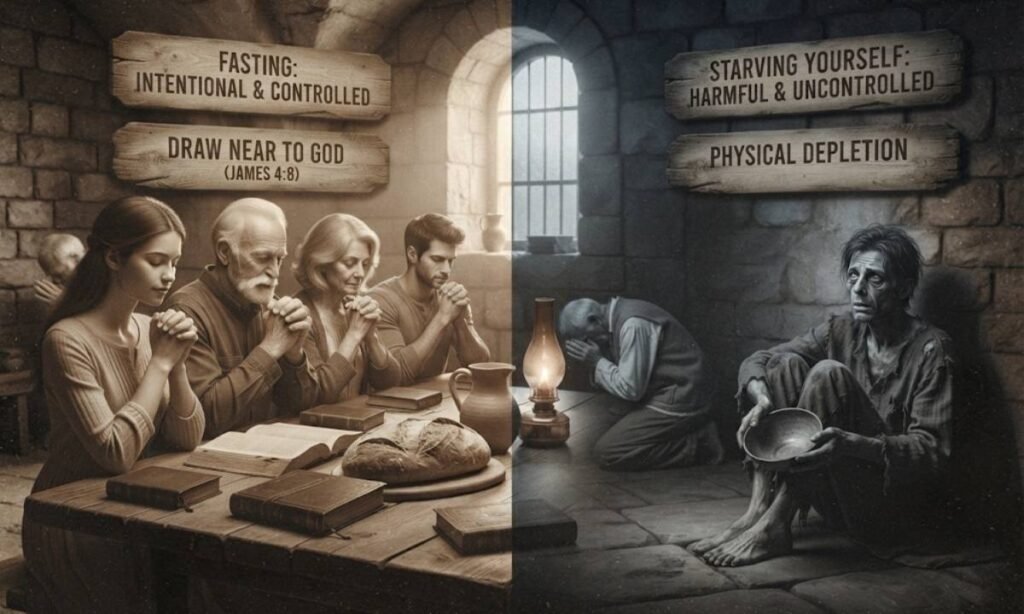
Fasting and starving yourself are not the same thing.
Biblical fasting is voluntary, purposeful, temporary, and connected with spiritual devotion. Starvation is the dangerous deprivation of nourishment and can cause serious physical harm.
A spiritual discipline should never become an excuse for ignoring medical needs.
If you have a medical condition, take medication that requires food, are pregnant or breastfeeding, have a history of disordered eating, or are otherwise medically vulnerable, seek qualified medical guidance before changing your eating pattern.
Healthy spiritual practice should involve wisdom.
Remember these distinctions:
- Fasting has a defined purpose.
- Fasting should not be used to punish your body.
- Fasting should not become a competition.
- Fasting should not be used to prove that you are more spiritual than others.
- Fasting should not replace necessary medical care.
- Fasting should remain centered on God rather than weight loss or appearance.
How to Prepare Spiritually Before Fasting?
Preparation begins before you skip a meal.
Start by deciding why you want to fast. Your purpose could be seeking direction, repentance, spiritual renewal, intercession, or simply creating more intentional time with God.
Write your main prayer focus in one sentence.
For example:
“Lord, help me seek Your wisdom about the decision I need to make.”
Then choose the Scriptures you want to read.
You can prepare by:
- Setting aside a specific prayer time
- Removing unnecessary distractions
- Writing down your prayer requests
- Choosing relevant Scripture passages
- Asking God to reveal areas that need correction
- Preparing appropriate food for afterward
- Informing trusted people if necessary
- Planning your schedule around rest and prayer
- Approaching the fast with humility
Preparation reduces the temptation to treat fasting as an impulsive challenge.
Bible Verses to Pray While Fasting 📖
Scripture can provide language when emotions make prayer difficult.
Here are 12 useful passages:
| Scripture | Prayer Focus |
| Isaiah 58:6 | Freedom and righteous action |
| Joel 2:12 | Returning to God wholeheartedly |
| Matthew 6:16 to 18 | Sincere private fasting |
| Ezra 8:21 to 23 | Protection and dependence |
| Nehemiah 1:4 | Intercession and grief |
| Esther 4:16 | Courage during crisis |
| Daniel 9:3 | Repentance and seeking God |
| Daniel 10:2 to 3 | Focused partial fasting |
| Psalm 51:10 | A clean and renewed heart |
| Psalm 121:7 to 8 | God’s protection |
| Philippians 4:6 to 7 | Prayer instead of anxiety |
| James 1:5 | Wisdom for difficult decisions |
These references are not magic formulas. Read them in context and let their themes shape your prayer.
Fasting in the Old Testament
Old Testament fasting appears in many different circumstances.
Moses fasted during a profound encounter with God. David fasted during times of intense sorrow and intercession. Hannah’s story includes deep prayer and anguish. Ezra and Nehemiah fasted while seeking God’s help for serious communal needs.
Daniel also provides an important example. Daniel 9:3 describes him turning to God with prayer, fasting, sackcloth, and ashes. His fast was connected with confession and seeking God’s mercy.
Esther 4:16 presents another powerful example. Esther asked her people to fast before she approached the king regarding the danger facing her community.
These accounts show that fasting can occur during:
- National crisis
- Personal grief
- Repentance
- Spiritual seeking
- Major decisions
- Danger
- Intercession
- Preparation for difficult responsibilities
The Old Testament therefore gives us a broad picture rather than one rigid fasting formula.
Fasting in the New Testament: Jesus and Disciples ✝️
Jesus fasted for forty days in the wilderness before beginning His public ministry. Matthew 4 records His response to temptation and His dependence on God’s Word.
Jesus also taught about fasting during the Sermon on the Mount.
His instruction was striking because He did not tell His followers to advertise their fasting. Instead, Matthew 6:16 to 18 teaches them to avoid making their spiritual discipline a performance for other people.
The early church also practiced fasting. Acts 13:2 to 3 describes believers worshiping, fasting, praying, and seeking God’s direction before sending Paul and Barnabas into ministry.
This provides an important lesson for modern Christians.
Fasting can accompany action. It is not merely sitting and waiting. After seeking God, believers may still need to make wise decisions, have difficult conversations, serve others, or take responsible steps.
The Rewards of Fasting According to Jesus: Matthew 6
Matthew 6 focuses heavily on motive.
Jesus discusses giving, prayer, and fasting in the context of avoiding religious performance. His message is that spiritual practices should not become tools for gaining human admiration.
When fasting, ask:
- Am I seeking God or attention?
- Am I trying to surrender or control?
- Am I becoming more compassionate?
- Am I listening as well as asking?
- Is this practice changing my heart?
- Am I becoming more obedient?
The reward of fasting should not be reduced to receiving a specific material outcome.
A person may finish a fast without receiving the exact answer requested. Yet the experience can still produce deeper humility, clarity, repentance, patience, and trust.
That distinction protects fasting from becoming transactional.
Prayer of Repentance and Cleansing Before Fasting 🕊️
“Lord, I come before You honestly. Search my heart and reveal anything that is keeping me from walking closely with You. Forgive my sins, pride, selfishness, bitterness, and careless choices.
Create in me a clean heart and renew my spirit. Help me not only confess what is wrong but also change the habits that keep pulling me away from You.
During this fast, teach me to surrender rather than pretend. Give me humility to accept correction and courage to make necessary changes.
May this time draw me closer to You and make my life reflect Your love more clearly. Amen.”
Psalm 51 is a natural companion for this type of prayer because it centers on repentance and renewal.
Prayer for Seeking God’s Direction and Guidance 🌿
“Father, I need Your wisdom.
There are decisions I cannot fully understand on my own. During this fast, quiet the noise around me and help me recognize what is wise, truthful, and consistent with Your Word.
Protect me from decisions driven by fear, ego, pressure, or impatience.
Give me patience when the answer is not immediate. Help me recognize wise counsel and remain willing to change direction.
If a door is right for me, help me walk through it responsibly. If it is not right, give me the courage to let it go.
Guide my thoughts, priorities, relationships, and plans. Amen.”
James 1:5 specifically encourages believers to ask God for wisdom.
Prayer for Spiritual Breakthrough and Open Doors 🔥
“Lord, I bring every obstacle and uncertainty before You.
Where I have become discouraged, restore my courage. Where I have lost direction, give me wisdom. Where fear has limited my choices, strengthen my faith.
Open the opportunities that are genuinely good for me and close doors that would lead me away from Your purposes.
Help me understand that breakthrough may involve changing my heart, habits, expectations, or direction rather than simply changing my circumstances.
Teach me to recognize progress even when it arrives gradually.
I surrender my timeline to You and ask for the grace to remain faithful while I wait. Amen.”
Prayer Against Evil Attacks and Bondage 🙏
“God, be my refuge and strength.
Protect my mind from destructive thoughts and my heart from bitterness, hatred, fear, and despair. Help me recognize unhealthy influences and respond with wisdom rather than panic.
Give me courage to seek help when I need it and strength to reject habits that keep me trapped.
Let Your truth guide my decisions.
I place my fears, relationships, responsibilities, and future in Your hands. Help me walk in wisdom, love, self control, and faith.
Keep me close to You and teach me to respond to darkness with truth and goodness. Amen.”
Prayer for Victory Over Temptation and Sin
“Father, strengthen me when temptation comes.
Help me recognize the situations, habits, and thoughts that repeatedly pull me away from what I know is right.
Give me self control when I feel weak. Help me replace unhealthy patterns with choices that reflect my faith.
When I fail, keep me from hiding in shame. Give me courage to repent, learn, and begin again.
Teach me that spiritual growth is not pretending I never struggle. It is continually turning back toward You.
Help me walk with integrity when nobody is watching. Amen.”
Prayer for Restoration of Joy, Peace and Hope 🌈
“Lord, restore what discouragement has taken from me.
When my mind feels exhausted, give me rest. When I feel disappointed, remind me that one difficult chapter does not define my entire story.
Restore my ability to notice simple blessings.
Help me stop carrying tomorrow’s problems today. Give me peace about what I cannot control and wisdom for what I can change.
Renew my hope without making me dependent on perfect circumstances.
Let joy return through gratitude, healthy relationships, meaningful work, worship, and a deeper awareness of Your presence.
Amen.”
Prayer Against Spirit of Delay and Stagnation
Instead of treating every delay as evidence of a supernatural attack, use this prayer to examine both spiritual and practical causes of stagnation.
“Lord, show me what is keeping me from moving forward.
If fear is holding me back, give me courage. If poor habits are slowing me down, give me discipline. If I need better wisdom, teach me.
Help me distinguish between waiting for Your timing and avoiding responsibility.
Give me patience without passivity. Give me ambition without pride. Help me take wise steps while trusting You with the outcome.
Make me faithful in small responsibilities while I wait for larger opportunities. Amen.”
Prayer to Break Generational Curses
Christians hold different theological views about generational curses, so this prayer focuses on repentance, freedom from destructive patterns, and building healthier choices.
“Father, I bring the unhealthy patterns in my family before You.
Help me recognize cycles of anger, addiction, dishonesty, abuse, fear, financial irresponsibility, resentment, or other destructive behaviors that have been repeated.
Give me courage to seek forgiveness and appropriate support.
Help me choose a different path where change is needed. Teach me to establish healthier habits and relationships for the generations that come after me.
Let my life become evidence that destructive patterns can be confronted and replaced with wisdom, love, responsibility, and faith.
Amen.”
Prayer for Healing, Protection and Strength ❤️
“Lord, strengthen me in every area where I feel weak.
Give me wisdom regarding my physical and emotional needs. Help me care for the body and life You have given me.
Protect me from unnecessary danger and guide me toward wise decisions.
When I am exhausted, help me rest. When I am afraid, help me seek support. When I feel alone, remind me that I do not have to carry everything without help.
Give me endurance for today’s responsibilities and hope for tomorrow.
Amen.”
Prayer Against Poverty and Financial Attack 💰
“God, give me wisdom concerning money.
Help me become disciplined, honest, hardworking, and generous. Teach me to distinguish between genuine needs and unnecessary pressure.
Give me wisdom to manage what I have rather than constantly chasing more.
Open legitimate opportunities for productive work. Help me avoid dishonest schemes, impulsive decisions, destructive debt, and financial choices driven by comparison.
Give me patience to build stability over time.
May my financial decisions reflect responsibility, gratitude, generosity, and wisdom.
Amen.”
Prayer for Fruitfulness and Success of Hands 🌱
“Lord, bless the work of my hands with purpose.
Give me discipline to finish what I start and humility to learn from mistakes.
Help me become excellent without becoming obsessed with recognition.
Teach me to serve people through my skills rather than measuring my value only through results.
Where my efforts need improvement, give me wisdom. Where I need persistence, give me strength.
Let my work produce results that are honest, useful, and meaningful.
Amen.”
Prayer for Prosperity in Business and Work
“Father, guide my career, business, and professional decisions.
Give me creativity without dishonesty, ambition without greed, and confidence without arrogance.
Help me understand my customers, colleagues, responsibilities, and opportunities clearly.
Protect me from unethical shortcuts and partnerships that compromise my values.
Give me the patience to build sustainable success rather than chasing quick results.
If new opportunities come, help me evaluate them wisely. If something fails, help me learn instead of giving up.
Amen.”
Prayer for Marriage, Relationships and Homes 🏡
“Lord, bring peace into my relationships.
Teach me to communicate honestly, listen carefully, forgive wisely, and establish healthy boundaries.
For married couples, strengthen love, patience, respect, trust, and commitment.
For those hoping for marriage, give wisdom about character rather than appearances alone.
For families facing conflict, provide opportunities for reconciliation where reconciliation is healthy and appropriate.
Help every relationship in my life reflect honesty, kindness, accountability, and mutual respect.
Amen.”
Prayer for Children and Future Generations 👨👩👧👦
“God, protect the children in my family and community.
Give them wisdom, courage, good guidance, and healthy relationships.
Help the adults around them model integrity rather than simply demanding it from them.
Protect young people from exploitation, harmful influences, destructive comparison, and hopelessness.
Give future generations opportunities to learn, serve, create, and grow.
Help me contribute something positive that can outlive my own generation.
Amen.”
Fasting Prayer for Church Revival and Unity ⛪
“Lord, strengthen Your church.
Remove unnecessary division, pride, competition, and bitterness. Help believers focus on truth, love, service, humility, and the mission of sharing the gospel.
Give church leaders wisdom and accountability.
Help congregations care for vulnerable people and welcome sincere seekers.
Let revival begin with transformed hearts rather than impressive appearances.
Teach us to pray, serve, forgive, and work together faithfully.
May our communities see genuine love expressed through action.
Amen.”
Fasting Prayer for Nations and Leaders 🌍
“God, we pray for nations and leaders.
Give those with authority wisdom, humility, courage, and a commitment to justice.
Protect communities affected by violence, poverty, corruption, disaster, and displacement.
Give leaders the ability to make decisions that protect human dignity and promote peace.
Help citizens practice responsibility, compassion, and truthfulness.
Where conflict exists, create opportunities for peace.
Where people are suffering, raise up people willing to serve.
Amen.”
Common Mistakes During Fasting ⚠️
A sincere fast can lose its purpose when people become focused on performance rather than spiritual growth.
Avoid these common mistakes:
- Treating fasting like a competition
- Bragging about how long you fasted
- Assuming hunger automatically equals spiritual power
- Ignoring the biblical context of a passage
- Expecting God to fulfill a demand
- Neglecting compassion toward other people
- Using fasting as punishment
- Ignoring genuine medical concerns
- Becoming so focused on food that prayer disappears
- Treating every problem as a supernatural attack
- Refusing practical help when help is necessary
- Ending the fast without reflection or gratitude
Isaiah 58 directly challenges fasting that exists alongside oppression, conflict, or selfish behavior.
The heart behind the fast matters.
What to Eat Before and After Fasting: Health Guide? 🥗
Food choices around fasting depend on the type and duration of the fast.
For a short fast, a person may simply return to normal meals gradually. Longer or more restrictive fasts require greater caution.
A sensible approach includes:
- Eating balanced meals before a planned fast
- Avoiding excessive overeating beforehand
- Drinking adequate fluids when the chosen fast permits fluids
- Choosing nutritious foods after the fast
- Eating slowly rather than immediately consuming a huge meal
- Paying attention to physical warning signs
- Seeking medical guidance when appropriate
People with medical conditions or special nutritional needs should not assume that a religious fast is automatically safe.
The spiritual purpose of fasting does not require reckless treatment of the body.
How to End Your Fast Safely: Spiritual and Physical
Ending a fast is part of the process.
Physically, avoid turning the first meal into a reward feast. Start appropriately for the type and duration of your fast.
Spiritually, end with gratitude rather than simply thinking about food.
Consider:
- Thanking God for the opportunity to seek Him.
- Reviewing what you prayed about.
- Writing down insights or convictions.
- Identifying practical actions you need to take.
- Continuing prayer after the fast ends.
- Remaining patient if the answer is not immediate.
The goal is not to return to exactly the same habits that existed before the fast.
If the fast has encouraged greater discipline, prayer, compassion, or Scripture reading, carry those practices forward.
Signs God Is Answering Your Fasting Prayer ✨
Not every answer looks like an immediate miracle.
Sometimes an answer appears as clarity. Sometimes it comes through changed priorities, wise counsel, an unexpected opportunity, a closed door, repentance, restored peace, or the strength to continue waiting.
Look for fruit rather than forcing interpretations.
Possible signs of spiritual growth include:
- Greater peace about a decision
- Increased desire to read Scripture
- Conviction about unhealthy behavior
- Willingness to forgive
- Greater patience
- More compassion for others
- Courage to take a responsible step
- Freedom from a destructive habit
- Improved ability to recognize unhealthy influences
- Greater trust in God even without immediate results
Fasting should not train you to see every coincidence as a divine message. Test impressions carefully and compare them with Scripture, wisdom, and sound judgment.
What Fasting Can Teach You About Your Habits? 📱
One of the most useful modern applications of fasting is learning what controls your attention.
Food may be the traditional focus, but many people also struggle with constant digital stimulation.
You can use a fasting period to reduce:
- Social media scrolling
- Entertainment
- Unnecessary notifications
- Gossip
- Constant news consumption
- Impulsive shopping
- Negative online conversations
- Other distractions that dominate your attention
For Gen Z and social media users, this can be especially meaningful.
Imagine replacing one hour of scrolling with Scripture, prayer, journaling, worship, or serving someone.
That does not make a digital break identical to a biblical food fast. Instead, it can become an additional discipline that supports a more focused spiritual life.
How to Build a Scripture Based Fasting Plan?
A practical plan can keep your fast from becoming vague.
| Stage | What to Do |
| Before | Choose your purpose and schedule |
| Start | Pray and read selected Scripture |
| During | Return to your prayer focus throughout the day |
| Reflect | Write down thoughts and convictions |
| Act | Follow through on practical responsibilities |
| End | Give thanks and return to food appropriately |
| Continue | Maintain useful spiritual habits afterward |
Choose a manageable Scripture list rather than trying to read the entire Bible during one fasting period.
For example, you could spend one day studying Isaiah 58, another day reflecting on Matthew 6, and another considering Daniel’s prayers.
The purpose is depth rather than volume.
Final Encouraging Prayer to End Your Fast 🙌
“Father, thank You for meeting me during this time of prayer and fasting.
Thank You for every moment of reflection, every Scripture that challenged me, and every reminder that I need Your wisdom.
I surrender the requests I have brought before You. Help me trust You even when answers take longer than expected.
Do not let this fast become only a temporary experience. Let the lessons continue in my choices, relationships, work, habits, and faith.
Give me strength to act on what I have learned.
Help me walk forward with humility, courage, patience, wisdom, and hope.
Where I need to wait, teach me patience. Where I need to act, give me courage. Where I need to change, give me humility.
May my life reflect the transformation I have prayed for.
Amen.”
Frequently Asked Questions
What are the best fasting scriptures for breakthrough?
Isaiah 58:6, Joel 2:12, Ezra 8:21 to 23, Matthew 6:16 to 18, Daniel 9:3, and Esther 4:16 are useful passages to study in context.
How long should I fast for a breakthrough?
The Bible gives examples of different fasting periods, so there is no universal duration that guarantees a particular answer.
Can I drink water while fasting for a breakthrough?
It depends on the type of fast, but hydration and medical safety should take priority; people with health concerns should seek professional guidance.
What should I do while fasting besides praying?
Read Scripture, worship, reflect, journal, serve others, reduce distractions, and take practical steps consistent with what you are praying about.
Does fasting guarantee a breakthrough?
No. Biblical fasting is not a method for forcing a desired outcome from God, but a practice of seeking Him with humility and trust.
What if I break my fast accidentally?
Do not turn an accidental mistake into shame. Pause, pray, reassess your plan, and continue wisely if appropriate.
Can fasting help with generational curses?
Fasting can accompany prayer for repentance and freedom, but Christians differ on how they understand generational curses and their application today.
Conclusion
Fasting is not about proving how strong you are or forcing God to answer according to your preferred timeline. It is a spiritual discipline that can create intentional space for prayer, Scripture, repentance, reflection, and surrender.
The most meaningful fasting scriptures for breakthrough point beyond the act of going without food and toward a transformed heart. Isaiah 58 especially reminds believers that genuine devotion should affect how they treat other people and live out their faith.
If you are beginning a fast, choose your purpose carefully, prepare wisely, and keep your focus on God rather than public recognition.
Pray honestly. Read Scripture thoughtfully. Take practical action where necessary. Remain patient when answers take time.
And remember that breakthrough can look different from what you expected. Sometimes it is a changed circumstance. Sometimes it is new wisdom, restored peace, repentance, courage, or strength to continue.
Let your fast lead to lasting faith, not just a temporary experience. 🙏